
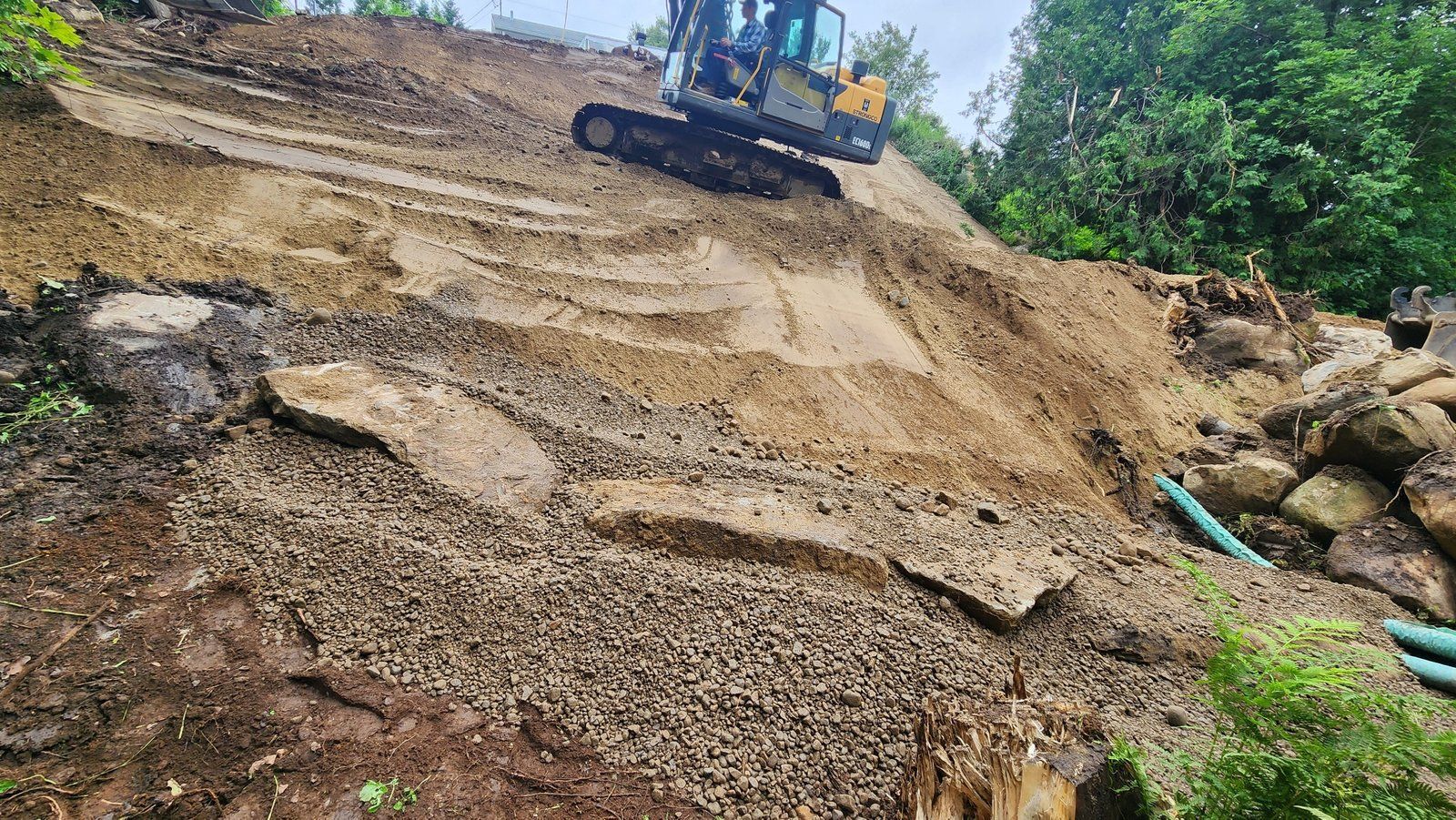
In Quebec, most landslides occur in clay deposits, mainly in the St. Lawrence Valley. A slope along a river, sloping ground behind a house or a road embankment can give way after heavy rain, a flood or poorly placed work. Quite often, the ground gives warning signs.
Signs to watch for
The Government of Quebec recommends reporting the following to your municipality:
- a crack in sloping ground;
- a bulge in a slope;
- a small collapse or a small slide;
- an unusual flow of water from a slope.
The Ministère des Transports also cites an arc-shaped crack and a ridge of soil at the base of the slope.
A retaining wall that leans, cracks or shifts also warrants a specialist’s opinion.
What to do after a landslide
- Move away from the area and stay away until the authorities advise otherwise. In case of immediate danger, call 9-1-1.
- Notify your municipality, then your insurer and your mortgage lender.
- Document the damage: photos of the slope, the cracks and the buildings, with the date.
- Have the situation assessed by a geotechnical engineer. The engineer diagnoses the landslide, looks for its causes and recommends the emergency measures and the stabilization solution.
A landslide is a distressing event. The Info-Social 811 service (option 2) offers psychosocial support.
Government financial assistance
Damage caused by a landslide may be eligible, under certain conditions, for the General Financial Assistance Program Regarding Disasters: for example, for a principal residence and losses not covered by insurance. Contact your insurer first, then identify yourself as a disaster victim with your municipality.
In Saint-Damien, for example, we designed the stabilization of a slope on private property, with funding and oversight from the Ministère de la Sécurité publique.
Why a slope slides
Several factors, often combined, can cause a landslide:
- soil that is too weak or poorly compacted;
- an overload at the top of the slope: fill, building, swimming pool, storage;
- an excavation at the base of the sloping ground;
- erosion of the toe of the slope by a watercourse;
- a natural event: intense rain, rapid snowmelt, flooding or an earthquake.
In clays, the landslide is often rotational: the soil slides along a curved failure surface and leaves a spoon-shaped scarp at the top.
Building near a slope: constraint zones
Regional county municipalities (RCMs) include in their land use plans the maps of areas potentially exposed to landslides, with standards that govern construction, additions and work in these areas. These standards may prohibit a project, unless an expert assessment by a geotechnical engineer who is a member of the Ordre des ingénieurs du Québec shows that it is safe. Before buying or building near a slope, check the zoning with your municipality.
How a slope is stabilized
The solution is chosen after a stability study, in two steps: characterization of the soil through boreholes, then stability analysis using conservative methods or specialized software. It depends on the configuration of the site, the access and the budget. The common solutions are:
- regrading: flattening the slope or cutting down the crest to reduce the loads;
- a berm or a toe buttress: adding a weight of soil or rock at the base of the slope to hold it in place;
- riprap: an armour of large blocks that protects the toe against erosion, especially along a watercourse;
- drainage: removing the water that weakens the soil;
- reinforcement: ground anchors or a retaining wall.
Plans and specifications then govern the work, which the engineer supervises through to the certificate of compliance.
Our projects
- Road and slope in Sainte-Germaine-Boulé: stabilizing berm and rehabilitation of a road closed by a landslide.
- Slope along the rivière Noire, in Sainte-Cécile-de-Milton: hydraulic study and riprap stabilization after a rotational landslide.
- Slope in Saint-Damien: riprap after the collapse of a slope and its homemade wall following heavy rain.
How much a stability study costs
A ground or slope stability check costs between $3,000 and $7,000, depending on the site conditions and the available data. The design of the solution, the plans and specifications and the construction supervision are set by quote. See our guide on the cost of a geotechnical study.
Worried about a slope? Contact a Groupe LAFI engineer or see our page on geotechnical studies.
Sources
- Government of Quebec, “Landslide” (what to do before, during and after): quebec.ca.
- Government of Quebec, financial assistance for disaster victims (property owners and tenants): quebec.ca.
- Government of Quebec, government land use planning guidelines on landslides (in French), 2016: cdn-contenu.quebec.ca.
- Ministère des Transports, technical bulletin on the signs of slope instability (in French), 2013: transports.gouv.qc.ca.