
A geotechnical study has no fixed price: a house on well-known sandy soil does not call for the same work as a slope that has slid along a riverbank. The cost depends mainly on three things: the purpose of the study, the investigation method and what is already known about the site. Here are Groupe LAFI’s price ranges and what makes them vary.
Our price ranges
| Type of study | Indicative price |
|---|---|
| Soil bearing capacity for a house or cottage | $4,500 to $7,500 |
| Ground or slope stability check | $3,000 to $7,000 |
| Advanced seismic analysis (soil liquefaction risk) | From $8,000 |
| Commercial or industrial building, street, municipal structure, dam | By quote |
These amounts are indicative. The exact price is given in the quote, once the project and the site are known.
What makes the price vary
The purpose of the study
New construction, an addition and a repair do not raise the same questions. For a new house, the study focuses mainly on the soil’s bearing capacity and the type of foundation. After a landslide, it must also analyze the stability of the slope and design a solution. The more questions there are to answer, the more test holes, tests and analyses are needed.
The number and depth of test holes
Each test hole describes the soil at one specific spot. A small building on uniform ground may need only a few test holes; a large building, a street or a site where the soil changes from one point to the next calls for more of them, and deeper ones.
The investigation method
The tools do not all cost the same to mobilize:
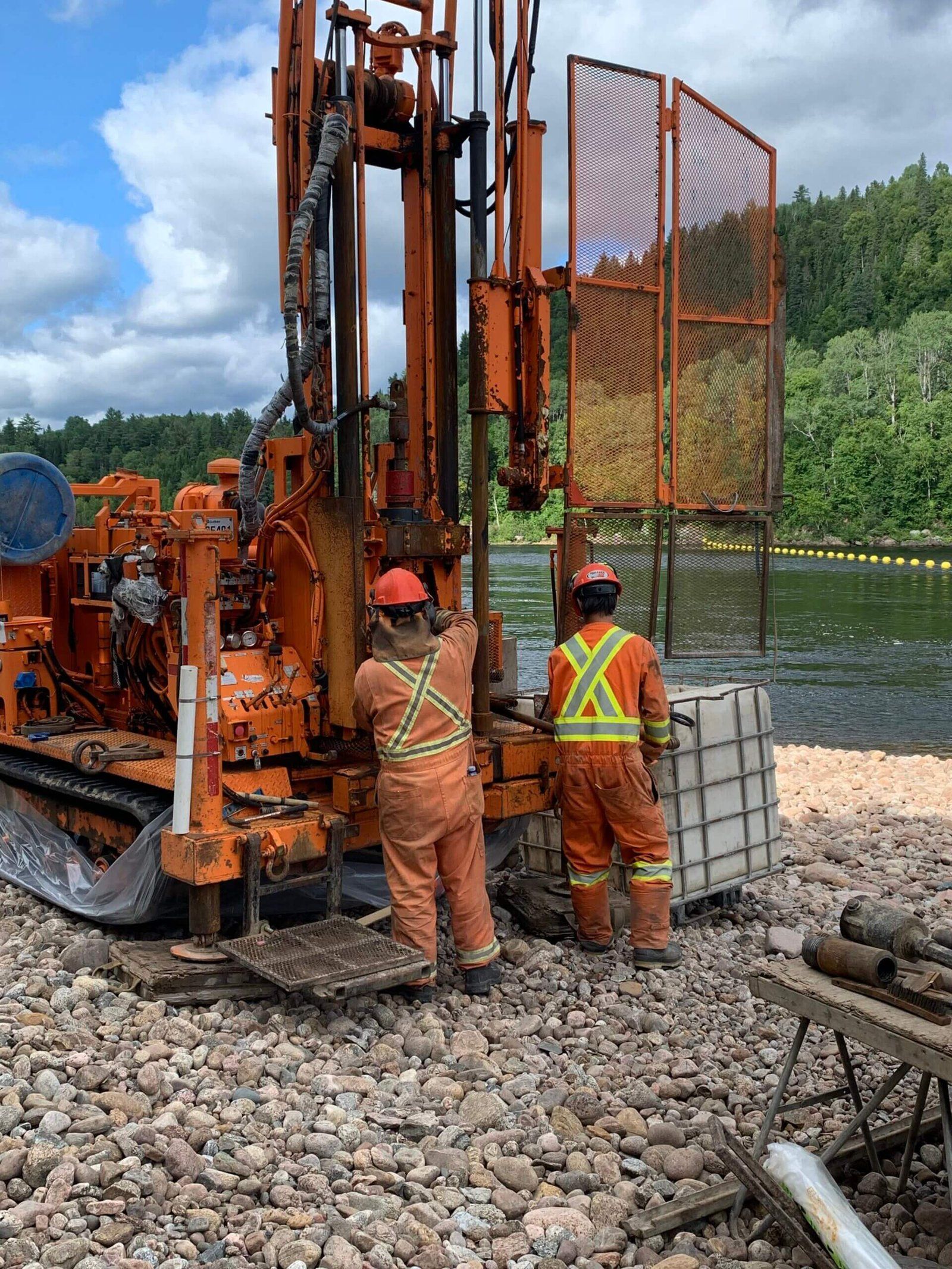
- drilling with a drill rig, with N-value measurement (SPT test), goes deep and collects samples at regular intervals;
- manual boreholes and test pits are suited to shallow investigations and to sites that are hard to access;
- the Panda dynamic penetrometer, light and portable, measures the resistance of the soil where a drill rig cannot go;
- the seismic piezocone, the MASW method and seismic lines are used when the seismic site class or the depth of bedrock must be known.
The engineer chooses the method that answers the question most cost-effectively.
Site access
A wooded, sloping, landlocked or snow-covered site may require special equipment or more time on site. Winter does not prevent drilling, but it can make access more difficult.
Available data
Previous studies on the site or nearby, surficial deposit maps or neighbouring boreholes reduce uncertainty. They can reduce the number of test holes needed. That is why our price ranges vary “depending on the available data.”
Laboratory and advanced analyses
The samples go to the laboratory, notably for grain size and hydrometer analyses. The risk of soil liquefaction is analyzed for every construction project, starting with a preliminary analysis. If it reveals a risk, the study adds an advanced seismic analysis; depending on the project, it may also add a numerical stability analysis or the design of a ground improvement technique. Each of these is added to the base price.
What the price includes
A geotechnical study generally includes three steps:
- Data collection on the site: location, previous studies, types of deposits.
- The field investigation: test holes, in situ tests, laboratory tests and water level measurement.
- The geotechnical engineer’s report: description of the soil, bearing capacity, seismic risk and recommendations for the foundations, drainage and excavation.
Why the study often saves money
Without soil data, foundations are designed “just in case”: wider, deeper, sometimes on piles when a conventional foundation would have been enough. The study makes it possible to optimize the type and dimensions of the foundations and to avoid costly oversizing.
Conversely, building without knowing the soil exposes you to settlement, especially on the clay soils of the St. Lawrence Valley, which can be highly compressible. Repairing foundations after the fact costs far more than the study.
How to get an accurate quote
To give you a fair price quickly, have the following ready:
- the address or lot number of the property;
- the type of project: house, cottage, addition, commercial building, street, wall, slope;
- the plans or the planned layout, if you have them;
- any studies already carried out on the property;
- your schedule and any known access constraints.
The price of a project depends on its site: request a quote or see our page on geotechnical studies. For a house, also read our guide on geotechnical studies for a house or a building lot.
Sources
- Groupe LAFI, Geotechnical study: frequently asked questions (price ranges and steps of the study).
- Régie du bâtiment du Québec and Société d’habitation du Québec, bulletin Caractéristiques des sols argileux (in French), April 2006: collections.banq.qc.ca/ark:/52327/bs38393.