
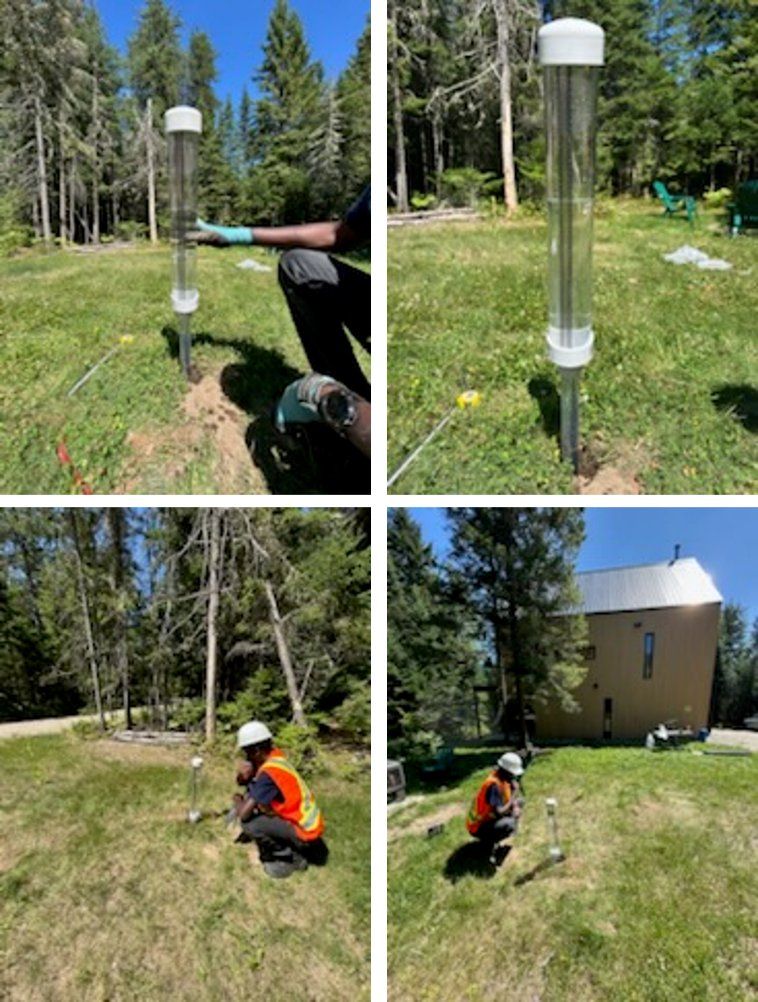
A house that is not connected to a sewer system treats its wastewater on site, with a septic system. In Quebec, these systems are governed by the Regulation respecting waste water disposal systems for isolated dwellings (CQLR, chapter Q-2, r. 22). Before issuing a permit, the municipality requires a study of the land. The percolation test is one of the ways to measure the permeability of its soil.
When are a permit and a study required?
The regulation requires a permit from the municipality (from the regional county municipality in an unorganized territory) before:
- building an isolated dwelling;
- adding a bedroom to it;
- building or modifying a septic system.
The permit application must include a characterization study of the site and natural land, along with a site plan drawn to scale.
What the study must establish
Under section 4.1 of the regulation, the characterization study presents:
- the topography of the site;
- the slope of the disposal site;
- the permeability level of the soil, with the method used and the results;
- the level of the bedrock, of the groundwater and of the permeable, low-permeability or impermeable soil layers;
- any other element that may affect the location of the system.
These data determine which type of treatment system can be installed and where it can be placed on the property.
How soil permeability is measured
Permeability indicates how fast water moves through the soil. The Ministère de l’Environnement (MELCCFP) accepts three methods:
- the percolation test: a hole is dug and saturated with water, then the time the water takes to drop is measured, in minutes per centimetre;
- measuring the hydraulic conductivity of the soil, in centimetres per second;
- the correlation between soil texture and permeability: the grain size analysis of a sample places the soil in the texture triangle in Schedule 1 of the regulation.
The ministry recommends using at least two methods. If they give different levels, the regulation uses the lowest permeability level.
The four permeability levels
| Permeability level | Percolation time | Hydraulic conductivity |
|---|---|---|
| High permeability | Less than 4 min/cm | More than 4 × 10⁻³ cm/s |
| Permeable | 4 to less than 25 min/cm | More than 2 × 10⁻⁴ up to 4 × 10⁻³ cm/s |
| Low permeability | 25 to less than 45 min/cm | More than 6 × 10⁻⁵ up to 2 × 10⁻⁴ cm/s |
| Impermeable | 45 min/cm or more | 6 × 10⁻⁵ cm/s or less |
Soil that is too permeable lets the water through before it is treated; impermeable soil does not absorb it. In both cases, the system must be adapted to the land.
Who can sign the study?
For an isolated dwelling, the characterization study is signed by a professional within the meaning of the Professional Code, a member of a professional order that governs this activity. However, the regulation requires a member of the Ordre des ingénieurs du Québec or of the Ordre des géologues du Québec for the study, and an engineer for the plan, when the planned system is an above-ground sand-filter bed or a leaching field in a soil whose texture falls within the impermeable zone. For a building other than an isolated dwelling, the study is signed by an engineer or a geologist, and the plan by an engineer.
Soil testing with Groupe LAFI
Groupe LAFI prepares and signs the characterization study of the site and natural land required with the permit application. Our technicians dig the holes by hand or with an excavator, carry out the percolation tests with a permeameter and collect samples for grain size and hydrometer analyses in the laboratory. The study presents the elements required by the regulation: topography, slope, permeability level, bedrock level and groundwater level.
The price of the study for a septic system is set by quote, depending on the property and its access. See our soil testing page or request a quote.
Good to know
- The regulation has been amended several times, notably in 2020 for permit applications and in 2025 for flood zones and distances. Always check the version in force with your municipality.
- The ministry publishes a technical guide and a guide on establishing soil stratigraphy, which are useful to your system designer.
- If you are building the house at the same time, the geotechnical study for the foundations and the land study for the septic system can often be planned together. See our guide on geotechnical studies for a house.
Sources
- Regulation respecting waste water disposal systems for isolated dwellings, CQLR, c. Q-2, r. 22, sections 1 (permeability levels), 1.1, 4, 4.1, 4.3 and 4.4: legisquebec.gouv.qc.ca.
- Ministère de l’Environnement (MELCCFP), fact sheet on section 4.1 of the regulation (in French), revised in March 2021: environnement.gouv.qc.ca.
- Ministère de l’Environnement (MELCCFP), Guide technique (in French), Appendix B, percolation test protocol: environnement.gouv.qc.ca.
- Ministère de l’Environnement (MELCCFP), Établissement de la stratigraphie du sol (in French), 2023: environnement.gouv.qc.ca.